
Counterweights

The fundamental underpinning of “market forces” is akin to Newton’s Third Law. As in action-reaction. Commerce involves two (or more) parties that interact, and more importantly, react. One raises a price or degrades a product, the other might shop elsewhere. One lowers a price or improves a product, he might attract new customers. The interaction doesn’t happen in isolation or apart from the real world. Alternatives are available.
People don’t like that. The obvious case is the business owner seeking to achieve monopoly status, whether by undercutting or buying up the competition, or by getting the government to distort the market in his favor. The first two are part-and-parcel of “market forces,” and such strategies don’t work out in the long run. The third, unfortunately, is a tried-and-true method of personal gain at greater cost to the overall economy. Rent-seeking behavior LINK, especially when the government is large, is effective and lucrative.
The business owner is not alone in this. Consumers don’t like the vagaries of the market, so many look to the government to force businesses to provide goods and services on more favorable terms. Such rent-seeking behavior (it’s no different than what business owners do) is typically couched in more noble terms, such as safety or fairness or justice or equity, but it’s just another form of coercive taking of the fruit of others’ labor.
Speaking of labor... Organized labor in the private sector, aka unions, is an important and natural part of “market forces,” and serves to compensate for power imbalances between wealthy big business owners and individual workers. Where this goes wrong is the same place that the other elements of an economy (business and consumer) do - in seeking government involvement. Getting the one true monopoly in our society - the government and its sole control of coercion - to tip the scales in its favor.
To mute the effectiveness of the “reaction” part of market forces.
As bad as these distortions are for you and me and the economy as a whole, the damage is far, FAR worse when market forces are rendered nonexistent.
As is the case with public sector unions.
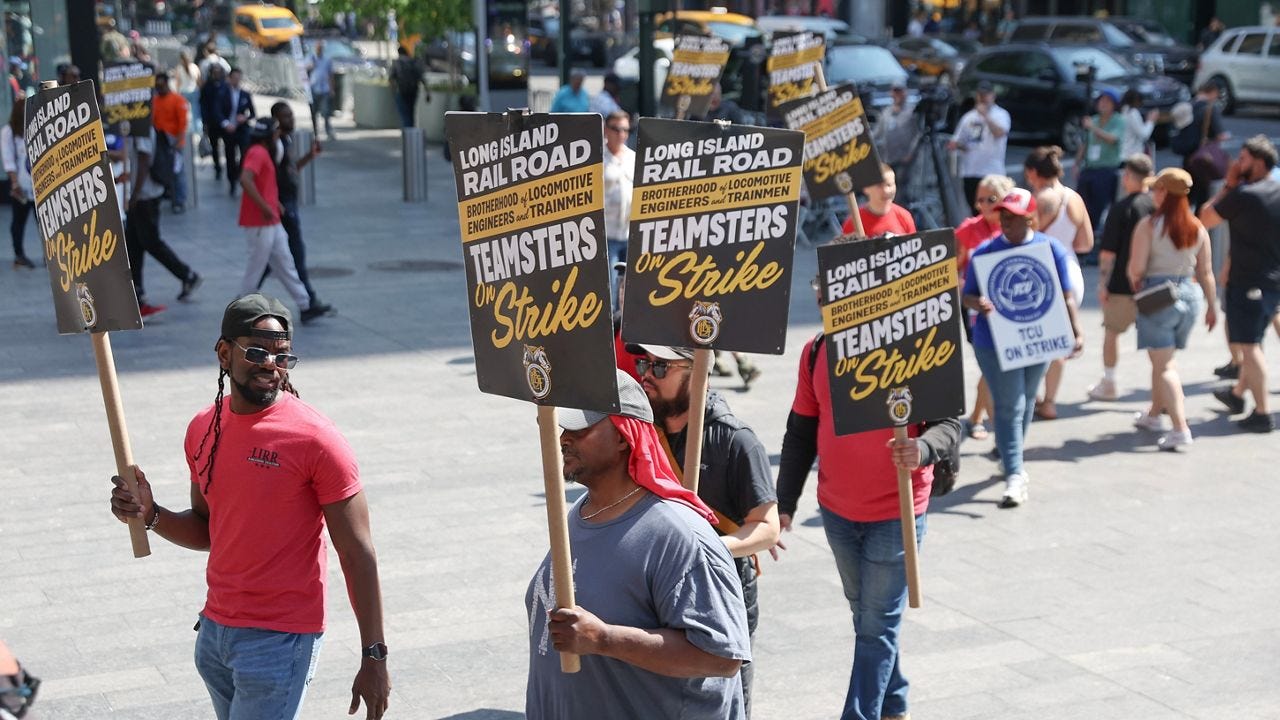
The New York metro area was briefly held hostage by a Long Island Railroad union strike. The LIRR is the busiest commuter rail in the nation, transporting a quarter million people to and from work every day. It is not a private business, competing with other private businesses, and thus subject to market forces. It is a government-run monopoly. The governor caved pretty quickly, and gave the already-over-paid workers a sweetheart deal.
This raises a fundamental question: What counterweight is there to the public unions’ power, and in particular to the destructive power of a strike by a public union?
There really isn’t one. The only counterweight is the politicians’ fear of voter wrath, which is nebulous and attenuated by a zillion other factors. Especially in a one-party state like New York.
This isn’t new thinking.
In 1919, then-Governor of Massachusetts (and eventual President) Calvin Coolidge responded to a strike by the Boston police union by stating that “There is no right to strike against the public safety by anybody, anywhere, any time.”
FDR, a champion of workers’ rights, nevertheless believed that public workers striking was anathema: “A strike of public employees manifests nothing less than an intent on their part to prevent or obstruct the operations of Government until their demands are satisfied. Such action, looking toward the paralysis of Government by those who have sworn to support it, is unthinkable and intolerable.”
Ronald Reagan famously fired 11,000 striking air traffic controllers.
These are the exceptions. These are the instances where the public good was elevated over the politician’s first goals of self-preservation and re-election.
Public unions have massive, election-tipping power. Living as they do off Other People’s Money, and insulated from market forces by the very people who sit on the other side of the bargaining table. A business owner’s negotiator facing a union boss should not be receiving bribes from the union boss, yet that is exactly what political contributions by public unions to political candidates are.
Taxpayers, the ultimate consumers of the services provided by those in the public unions, do not have a choice as to how their money gets spent. We cannot take our business elsewhere. We cannot apply market discipline to the equation. It is no surprise, then, that public unions continue to grow in power, and that public services continue to get more expensive even as their quality deteriorates.
This is not fixable by any changes in leadership. This is a structural problem, manifest at its core by the existence of public unions.
To repeat, private-sector unions serve an important role in a free market economy, as long as government provides neither benefit nor hindrance.
Public-sector unions, on the other hand, should not exist.
Absolutely correct public sector unions should not exist. Wish I could see some possibility of them going away.
Right on, Peter. Public unions have NOTHING to do with improving quality or making operations more efficient. Nope, nope, and nope. They're all about milking the system for every dime they can - and they usually accomplish that goal spectacularly. Can't say it enough: they should be abolished.