
Decluttering

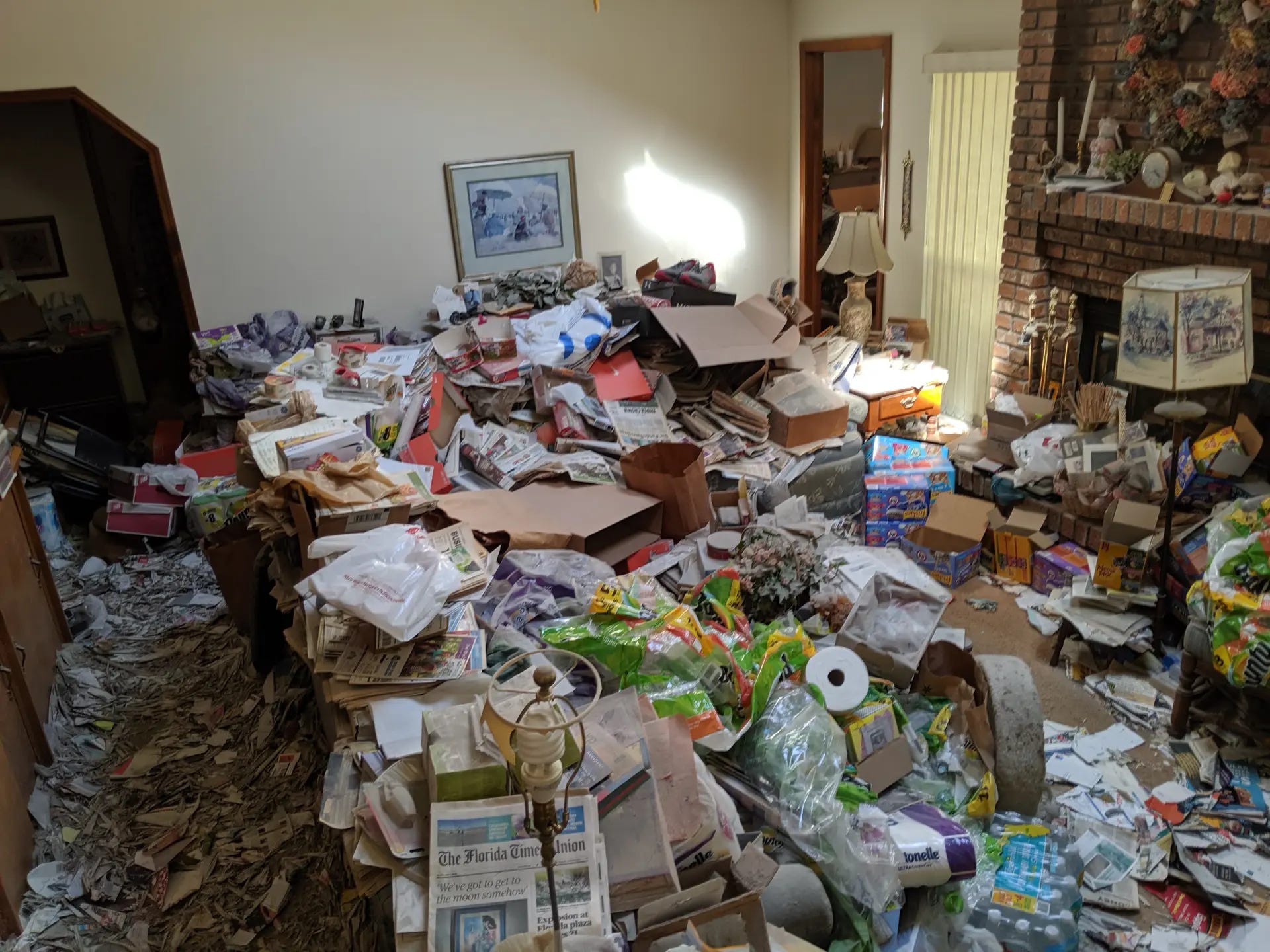
George Carlin titled his 1981 album “A Place For My Stuff.” It included his now-legendary eponymous bit, in which he pointed out that a house is just a “pile of stuff with a cover on it.” He also noted that people bought bigger houses in order to have room for more stuff.
The bit echoes every time I get into a de-clutter mode at home. Whether it be the kitchen, the basement, the garage, a closet, or a dresser, I catch myself doing what most of us do: look at something and reflexively say “I may use that some day.” It takes conscious effort to say “I haven’t worn those socks in two decades, throw them out,” but I’ve found that once I break that first line of resistance, it becomes much easier to throw more things away.
Sure, we’ve all had that moment of smug “see!” satisfaction when we finally use a piece of scrap wood or an old computer cable or some other relic that we’ve been saving for a decade. We’ve all had those moments of head-shaking “how could they let it get so far” when we see someone else’s excessive clutter or hoarding, ignoring that the difference between their state and ours is merely one of degree. I know I feel much greater catharsis after a good spring cleaning and junk-tossing than after saying “hah! That five inch scrap of two-by-three I didn’t chuck proved useful!”
Most of the time, clutter is benign. Annoying, but benign.
Sometimes, though, it can be hazardous. Some time back, I became aware of persons who, unbeknownst to us, had cluttered their home so badly that when one had an emergency, first responders had trouble getting them out of the house. That clutter led to government intercessions that caused a domino effect that ultimately required them to sell their home.
Clutter is a natural and persistent phenomenon, one that government is certainly not immune from. Our books are full of laws and regulations that are obsolete or useless or that conflict with each other, if for no other reason than there’s no natural cleaning force at play.
Ditto for jobs and programs. Indeed, the primary forces tend to preserve such long after their utility and purpose have passed. After a while, the purpose fades from memory, and uncertainty creates a Chesterton’s Fence scenario where people become afraid of eliminating something for which there appears to be no valid purpose.
Here’s where we have two instances of Good Trump.
One was highly visible and a great idea but flawed in execution, and ultimately fell prey to the Leviathan and its horde of dishonest, self-interested harpies and doomsayers.
That would be DOGE.
The other is under the radar but may be proving to be much more effective and a strong contributor to the economic strength that is offsetting the harm done by Trump’s missteps (see: tariffs and protectionism, among others).
That would be Executive Order 14192.
Enacted ten days after he took office in 2025, and titled “Unleashing Prosperity Through Deregulation,” it ordered federal agencies to repeal at least ten existing regulations for every new regulation introduced. It greatly expanded on his first-term two-for-one EO.
While we won’t know numbers for 2026 until 2027 (in the immortal words of a seventh grade friend of mine, “well, duh!”), we do know that the Federal Register, which lists every federal law, rule, and regulation, decreased in page count from a (record high) 106,109 pages in 2024 to 61,584 pages in 2025. That page count is a useful yardstick of how much the feds’ regulatory tendencies intrude into our lives.
By one estimate, regulatory compliance burdens the economy to the tune of $2.15 trillion every year. That’s make-work. That’s people getting paid to dig holes and fill them back up. That’s productive capital being burned for non-productive purposes. That’s opportunity cost. That’s workfare.
Yeah, yeah, someone’s bound to say “without regulation, people are going to die!!!”
To which I reply, “don’t be a [redacted] [redacted].” And I invoke Grice’s Razor, aka “you know what I mean.”
Every regulation, every law, every government job, every program, every agency should be periodically subject to zero-state scrutiny. Do we still need it? If we get rid of it, will anyone other than those riding the gravy train be harmed?
Of course, the gravy train is the problem. As I’ve pointed out ad nauseam on this blog, government is first and foremost about Other People’s Money. The eternal problem in shrinking government is the overriding power of concentrated benefit over diffuse cost. A given government program costs each taxpayer pennies, making it easy for the people who benefit from that program to point taxpayers at other programs or to argue that canceling theirs (or ones they like) won’t make much difference. You see it all the time - people arguing that ten million here or fifty million there in a seven trillion dollar budget is noise.
Between the Chesterton’s Fence crowd, the “people are gonna die!” crowd, and the “save the things I like” crowd, the declutter crowd is easily overwhelmed. The declutter crowd is, however correct. We don’t need a great many of the laws and regulations and programs and agencies that currently exist, and we’d be better off without them. Each of us should resist the temptation to fall in with one of the first three, just as we resist the temptation to keep those old socks or the “they’re now vintage and I’ll lose the weight” corduroys or the scrap of lumber or the seventeenth Cat-5 cable.
More than ever, our government could use a really good declutter.