
Do-Gooders and Liberty


Take note of the policies society’s do-gooders propose and propose and propose. Those policies are invariably aimed at controlling other people’s behavior. Yes, that includes my favorite refrain - Other People’s Money (OPM) - because it’s ultimately about how and on what that money is spent. If everyone voluntarily spent their hard-earned dollars as the do-gooders desired, they’d focus their attention on other things. The policies go well beyond OPM, though, and do-gooders’ persistence across history suggests something innate in human nature.
As Manuel Garcia O’Kelly-Davis, the protagonist of Robert Heinlein’s The Moon Is A Harsh Mistress, observed:
Must be a yearning deep in human heart to stop other people from doing as they please. Rules, laws—always for other fellow. A murky part of us, something we had before we came down out of trees, and failed to shuck when we stood up. Because not one of those people said: “Please pass this so that I won’t be able to do something I know I should stop.” Nyet, tovarishchee, was always something they hated to see neighbors doing. Stop them “for their own good”—not because speaker claimed to be harmed by it.
It should come as no surprise that TMIAHM was a huge influence on my political views.
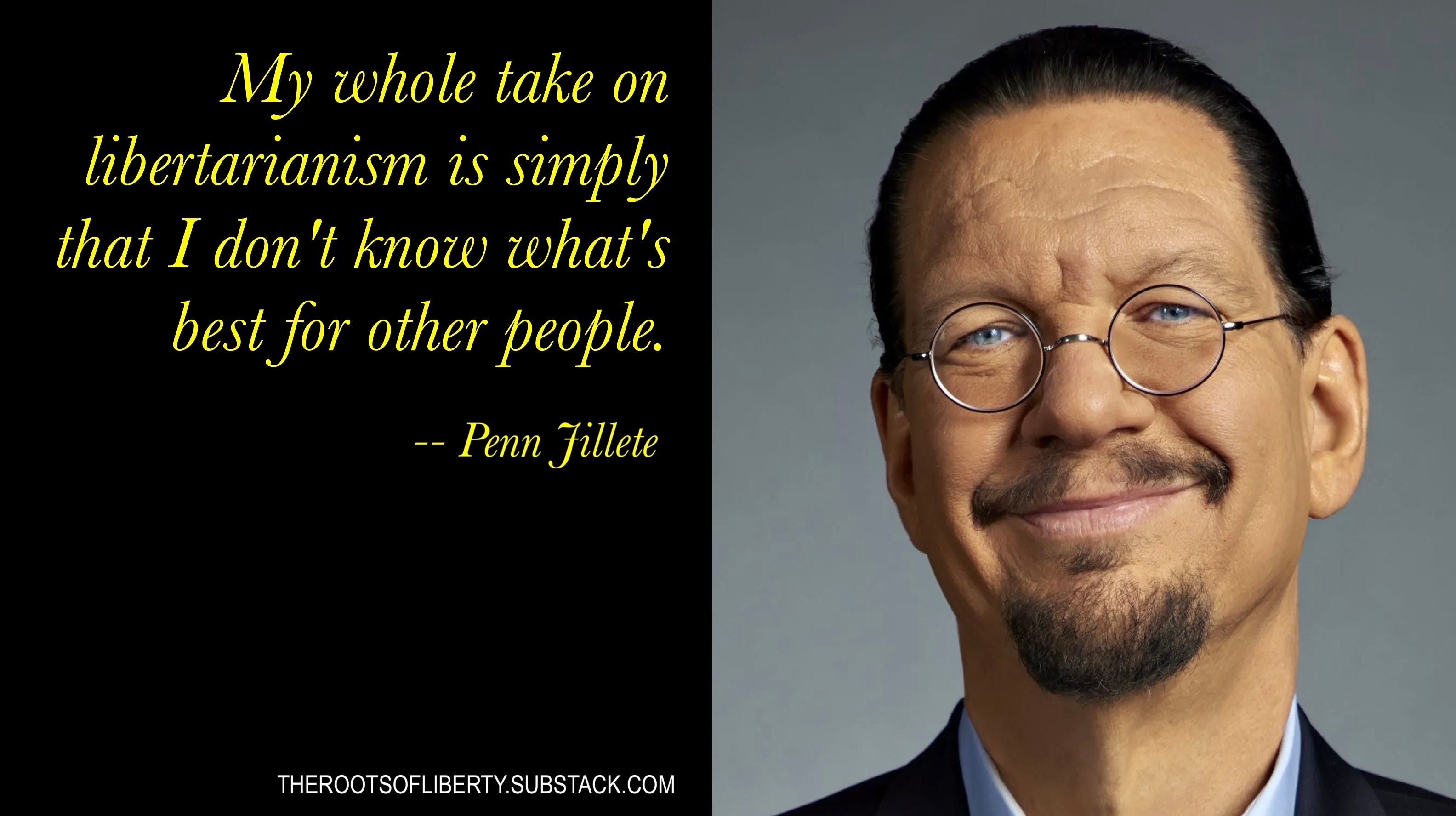
This brings me to a central tenet of libertarianism, one that mirrors Penn Jillette’s:
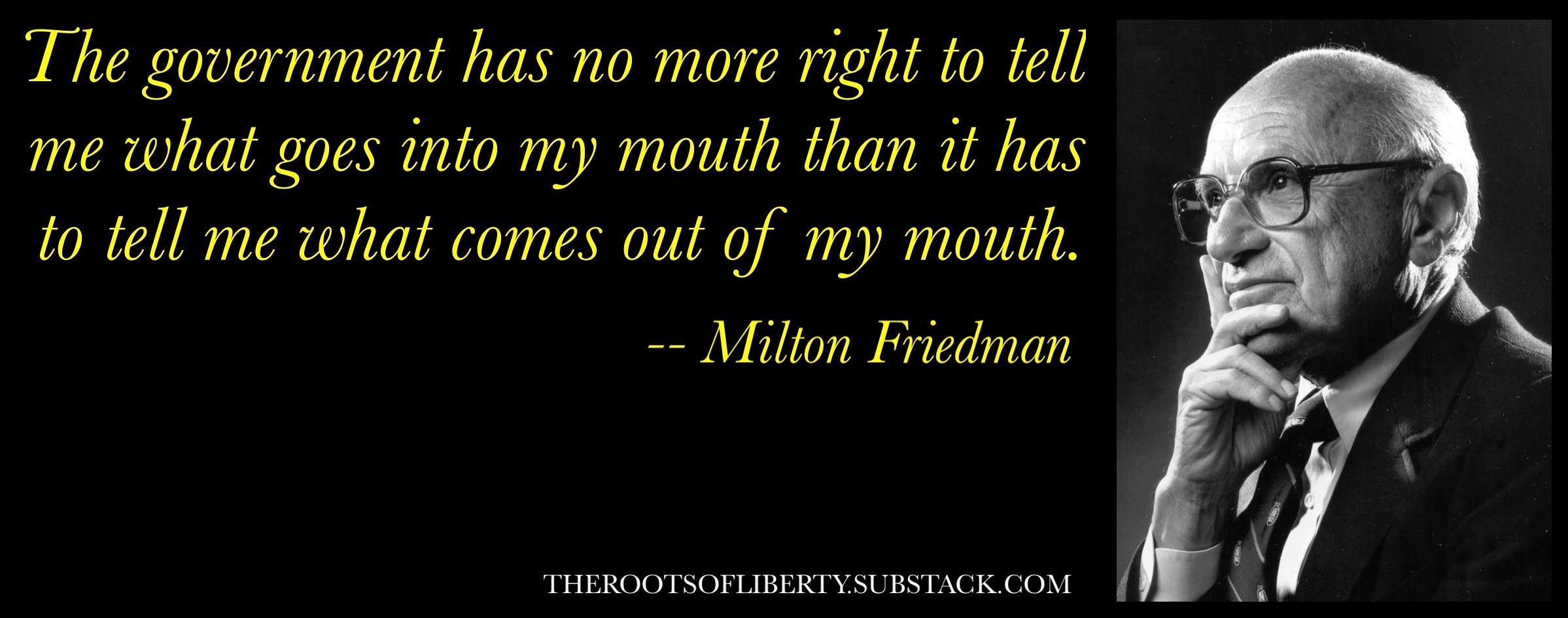
And this sentiment expressed by Milton Friedman:
I have been asked, many times, where the differences between libertarians and conservatives lie. Here is one: Conservatives are OK with government regulating or banning certain behaviors because they are bad for people. Libertarians are OK with people speaking and writing and posting and proselytizing against certain behaviors because they are bad for people, but object to government coercion.
The disparity comes down to the matter of individual primacy over “society.” Conservatives assert that “society” pays the price when individuals engage in self-harmful behavior. Setting aside the questions “according to whom?” and “is the alternative worse?”, the core philosophical/metaphysical question centers on self-determination.
The libertarian’s response to “society pays” is “society chooses to pay.” If I insist on buying you lunch, giving you no option to refuse, do I have a right to tell you what you can and cannot eat? Can you bootstrap yourself into authority over my choices, whether by assuming the financial burden or by putting a net under me? If I cannot opt out, then you have taken away my liberty by doing so.
In other words, what gives you the right to tell me I can’t engage in behaviors that you consider harmful to me?
Yes, even the freest society has the authority to punish those who harm others or others’ property. Your right to swing your fist ends at the tip of my nose. But, if my (or anyone else’s) nose is nowhere near you, I have no right to prohibit your fist swings.
Likewise, I can support society punishing someone for harming another, but not for harming himself, even if society has decided to intervene and mitigate that harm.
While the obvious prohibitions non-libertarians will default to include recreational drugs and sex work, the reality is that those are actually on the fringe of “for your own good” meddling. There is so much of it that we have become blind to it.
Another reflexive response points at children and the mentally ill. This is easily answered by the concept of informed consent. By definition (and by societal convention), children, not being fully formed humans, cannot consent. Similarly, the severely mentally ill, not being in their right minds, are not capable of informed consent. Here, we can justify state intervention. Minors are debarred from buying alcohol or tobacco, getting tattoos, signing contracts, taking on debt, serving in the military, and more, and your typical libertarian won’t have any problem with all that. We might argue (as I have) that it’s unjust to allow 18 year olds to serve in the military but not to drink beer, but that’s a debate on age of majority, not societal intervention on behalf of minors.
The fact that we have so much government meddling in consensual behaviors reinforces Manny Garcia’s observation, and reminds us that libertarianism has opponents on both ends of the cultural spectrum. If it were only Team Blue or Team Red in opposition, we’d be a lot freer than we are. With both sides of the duopoly grinding their pet peeves, lovers of liberty face an uphill battle.
Where did this come from? Certainly, the puritanical streak in earlier America had something to do with it. Religions are, after all, obsessed with behavior. If that obsession were kept out of secular society, I’d have no reason to mention it. People are free to believe what they wish, and to codify those beliefs in their religions. But, we know that this is not the case, that the religious spills over into the secular. Just today I was reminded of the Scopes Monkey Trial, where science teacher John T. Scopes was fined $100 for teaching evolution in public schools.
What about the Left, which purportedly eschews religious conservatism? The “for your own good” instinct manifests in myriad other ways, and is more universally targeted via coercive government. Again, believe what you want, just don’t impose your beliefs on others against their will.
Does this sort of liberty produce perfect results? No. People do stupid things all the time. Even under the strictest of prohibitions and supervisions. Yet nirvana fallacies are often brought up by controllers and prohibitionists as if they are legitimate reasons to justify the infringement of people’s freedoms.
The problem lies in the breaking of principle. Once you declare it OK to coerce or prohibit the behavior of adults of sound mind, you cannot go back and say “it’s wrong to impose policy X” and have a moral leg to stand on. Freedom then becomes whatever the ruling majority says it is, and even the Constitution’s enumerated powers and Bill of Rights can’t rescue us.
When it comes to liberty, principle matters. Just as free speech requires people tolerating things they don’t like to hear, freedom of action requires staying out of other people’s lives unless and until they infringe on your person or property. And, no, setting up a safety net for those who fall does not justify intervention, nor does falling into that net constitute an infringement. You chose to set that net. Its cost is on you.