
Grow or Die


The US national debt is inching toward forty trillion dollars. It is an incomprehensible figure. Humans are not wired to understand its magnitude, and descriptive tricks like “if you put dollar bills end to end, it would reach the Sun 13 times over” are still inadequate.
Our esteemed public servants in Washington, D.C. will be adding another half trillion to that total by year’s end, and the trend of deficit spending shows no indication of abating. Neither political party actually cares about the debt, because most voters don’t either. It’s an abstraction that gets lip service but no actual attention, because almost no one wants to see cuts to the things they want the government to spend money on. It’s always “cut the other guy’s budget,” and since the loudest and most stake-holding players are the ones trying to preserve or expand their priorities (and protect their pockets), cuts almost never happen.
And when they do, the doomsayers not only gather, they are abetted by people who claim they want cuts but demand those cuts be perfect, flawless, and do no one any harm. News flash: If you reduce spending, some people are going to stop receiving taxpayer dollars. Before lamenting their plight, ask whether what they receive is actually of any benefit and what opportunity cost has been incurred.
Given this reality, how can the nation put itself on a path of fiscal responsibility?
The answer lies in the phenomenon dubbed Hauser’s Law. The AI summary, which I paste rather than typing nearly identical words manually, is:
>the observation that U.S. federal tax revenue has stayed near 19.5% of Gross Domestic Product (GDP) since World War II. This stability persists despite major changes in top marginal tax rates, implying that higher tax rates do not automatically increase government revenue.
If tax revenue correlates to GDP, no matter what’s in the tax code, then the path forward is to maximize GDP growth via policy. That must be combined with some sort of spending discipline. If we admit that actual, substantive cuts are nigh-on impossible, then the next best thing would be to hold spending steady. This is its own challenge, but it’s more doable than cutting. Yes, garbage spending should be cut, as well - nothing says we can’t keep trying, but the “uncuttable” parts of the budget are so large that the only real way to address them is to grow, grow, grow.
Elon Musk believes that such growth is to be found in and via AI.
I agree.
Unfortunately, we not only have the luddites trying to slow AI, we have foreign actors engaging in agitprop to undermine AI... and we have the socialists whose agenda is the opposite of growth.
Socialism doesn’t believe in growth. You may hear otherwise, but the evidence is overwhelming. Both the according-to-Hoyle form practiced in places like the Soviet Union and the social-democracy version we see in Europe produced lower growth than we saw in America.
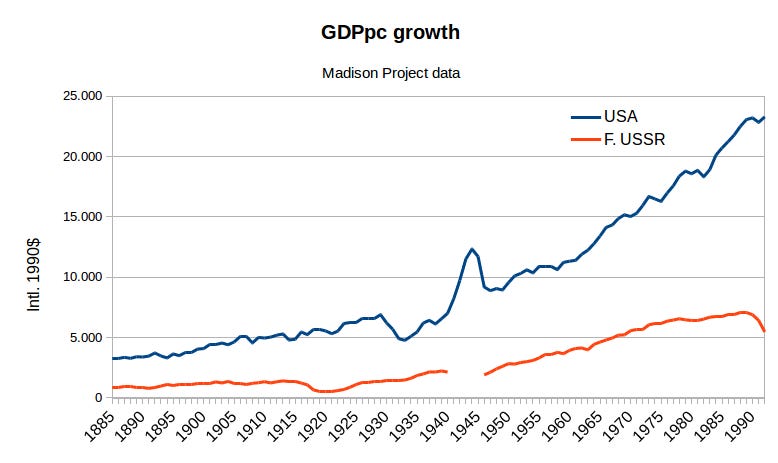
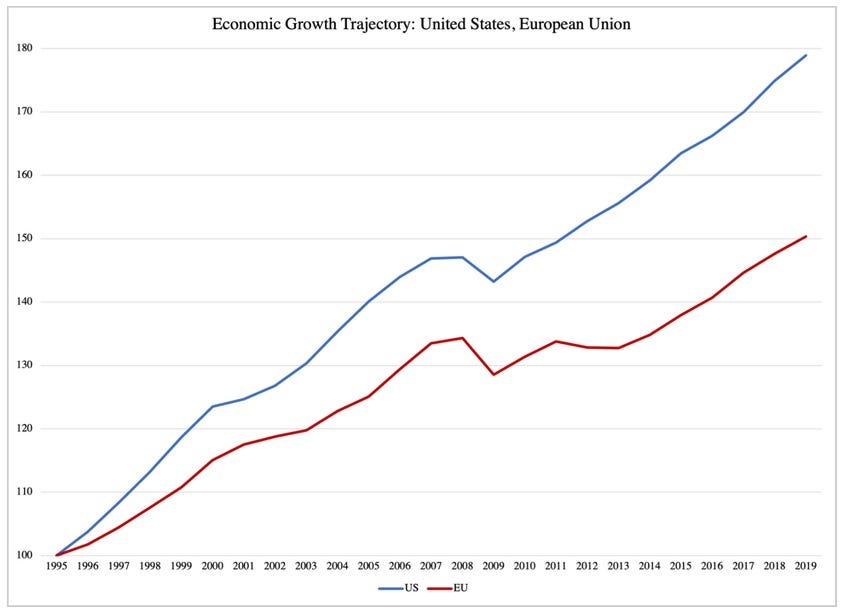
The Soviet Union imploded. (Western) Europe, is spiraling downward. The reason is simple: when you vilify and bleed out your society’s most productive, productivity itself suffers.
Our domestic socialists can think of only one thing: spending Other People’s Money. But spending is not investment. Spending does not promote growth. Worse, by taking that which is to be spent from those who would invest and produce and help grow the economy, it hinders* growth. The growth disparity between the US and old Europe now has European nations poorer than the poorest American states.
Their way is not the answer.
Unfortunately, neither is that of the current administration. While some policies (deregulation, energy) have benefited the economy and spurred growth, the protectionist ones are working in the opposite direction. History makes it clear that free market policies promote growth far better than any others.
Trump isn’t going to change his spots. His arc will continue to be a battle between pro-growth and growth-dampening policies. In the likely event that the Dems take control of the House, the pro-growth side will suffer, as will the possibility of spending cuts. More damage will be done, more debt will be accrued, and the pain the nation will inevitably feel when kicking the can down the road stops working will be greater.
So, what do we do? For now, press forward with pro-growth policies, support deregulation, and wholly embrace AI. Yes, that means barking back at your anti-data-center neighbors, who have been agitated by malevolent players working in the shadows.
Grow or die. It’s that stark.
Grow or die. It’s that stark. 😳😳 Well that’s a kick in the butt, Peter, and well deserved for sure! 👍 The real choice should be grow or cut spending, but no politician has the balls to cut spending, so our only choice is to grow our way out of this mess. The underlying issue is that we’ve become Santa Claus nation, where every day is Christmas and everyone eagerly anticipates getting more free stuff! This cannot continue without ultimately meeting a calamitous ending (think Thelma and Louise!).
The odd thing about this deficit spending is that most parents would never ask their children to give them money (or guarantee a loan) with no intent of paying that money back. But that is exactly what deficit spending does - it borrows from our children, saddling them with debt while the older generation enjoys stuff that is free to them, but a burden on future generations. Let’s hope growth is a viable solution, otherwise that light at the end of the tunnel is an oncoming train 🚆.
Spending as we do has a certain "momentum", if you think about it. That momentum is what we're fighting right now. Psychologically, it's far easier for Congress to go with the momentum than to try to resist. But that can - and will - change. I'm hopeful that the massive blatant fraud (my estimate is around one trillion per year) provides the "permission structure" to cut. Congresspersons like to think of themselves as "working" or "serving" us - yeah, they do! - and the visibility of widespread fraud pisses them off. This may just be the signal they need to realize "things got a little out of hand..." And yes, growth.