

EDITOR’S NOTE: Originally published October 2017. Republishing ahead of a broader look at what the growing surveillance state implies for our liberties.
“We must close the gun show loophole!”
Most of us have heard the adage “a little knowledge is a dangerous thing,” but how many of us actually respect the caution it suggests?
Far too few, I’m forced to conclude, especially when people who advocate greater infringements on gun rights start talking. The topic of this Gun Rights Lesson is a classic case in point. If you’ve debated the gun issue even a bit, you’ve very likely heard of the gun show loophole. And, I bet, a good number of you, no matter which side of the issue you stand, do not really know what this “loophole” is or is about.
The remedy to the “a little knowledge (actually, a little learning)...” is more knowledge, and here I offer you just that: an explanation of the gun show loophole. Or, more accurately, an explanation of why it’s a deceptive misnomer.
Let’s start with the basics.
To purchase a firearm from a licensed dealer in the United states, an individual must, at minimum, complete a Firearms Transaction Record (commonly known as ATF Form 4473), which asks certain questions that must be answered and attested to, and must pass a NICS background check. Some states and localities have additional rules and requirements, but the federal rules are absolute. Let me repeat: every person purchasing a firearm from a licensed dealer MUST pass a background check.
Where the “loophole” idea arises is from the lack of such a requirement for private transactions. Just as there are fewer rules regarding your selling your own car to someone than there are for an auto dealer selling a car, there isn’t an all-encompassing requirement that you, as a private citizen, run a background check on someone to whom you wish to sell a gun. As before, there are some state- and local-level rules, especially when it comes to registered firearms (e.g. pistols in many states), but, generally speaking, you as a non-dealer are not required to run a background check on the person you sell to. However, there are laws prohibiting your selling to someone not permitted to possess a firearm (e.g. a felon) in every state and at the federal level. So, if your buddy Charlie just finished a three year stretch at Attica or Folsom and you sell him a deer rifle when he gets out, you may end up in Attica yourself.
So, we’ve got rules about licensed dealer sales, and we’ve got rules about private sales. Where do gun shows enter into the mix?
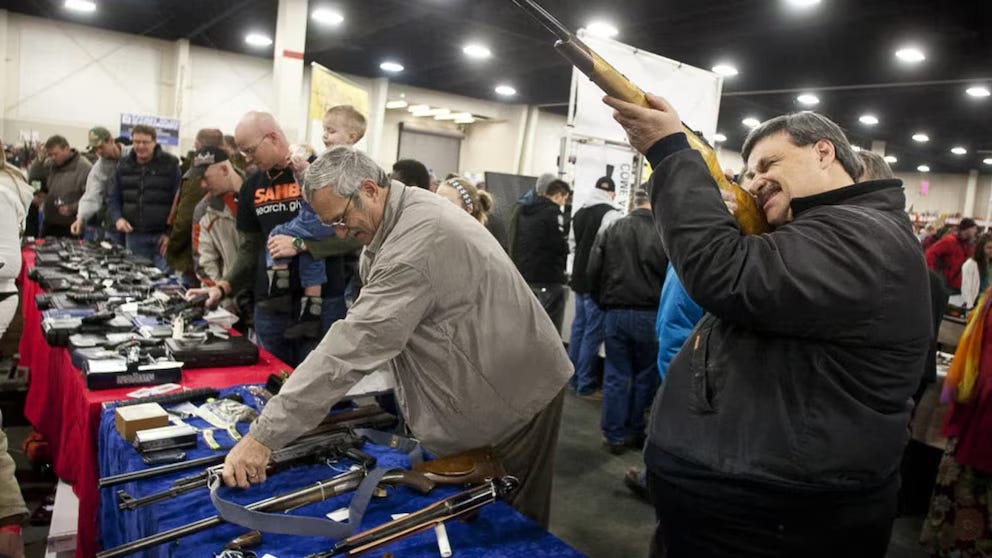
There is nothing special about a gun show. There are no exceptions, no rules, no loopholes written into any law book or registry of regulations. What there is, is the idea that private buyers and sellers can find each other at gun shows. Of course, they can also find each other on Craigslist, Marketplace, on a host of Internet websites, at a rifle or pistol range, at a church social, at a community garden, at a bake sale, at a yard/tag/garage sale, at a block party, at a museum fundraising event, at your friend Louie’s weekend barbecue, or at any other place where people get together to socialize.
The notion of the “loophole” stems from the idea that a private individual might set up a table at a gun show and sell guns without possessing a FFL (federal firearms license). Thing is - and given the hostility towards guns in this country - gun show organizers that allow this open themselves up to a world of trouble, and I’ve never been to a gun show that had anything but licensed dealers selling. In fact, every gun show I’ve ever been to has giant signs prohibiting the non-FFL sale of guns, either at the show or in the parking lot.
Thus, the “gun show loophole” is neither a loophole nor about gun shows. It’s singling out one place of many where private citizens can buy and sell guns from and to each other.
Whether you think this is a problem that needs addressing is a different matter. I address the practicality (and peril) of imposing a mandate for background checks in private transfers in depth here, but the short version is that, with hundreds of millions of guns in the US, without a national registry that tracks all of them, and with tens of millions of citizens who won’t (for very good reason) comply with a universal registration mandate, there’s no way to enforce background checks on private transfers. But, as I said, that’s its own issue, and its own debate.
At its core, it’s deceptive fear-mongering intended to soften the public up to further infringements on their Second Amendment rights.
So,
Gun rights lesson #804: The so-called gun show loophole is neither a loophole nor about gun shows. It’s a misleading phrase, intended to deceive people into thinking there’s a whole special chunk of gun society dedicated to selling guns to criminals. In fact, nothing could be further from the truth.
A footnote. The Biden administration attempted to “close the loophole” by requiring that anyone who sold a firearm for profit register as a dealer. The rule was challenged in court, and mooted by the Trump administration’s repeal of the rule earlier this year. I expect the next Democratic President to re-attempt this or a similar mandate, not because it will reduce gun crime, but because it’ll make it easier for the Feds to figure out where all the guns are.
We don't seem to ever see a statistic on number of guns used in crime legally purchased by the person using the gun. I'd bet on it being REALLY low. near zero probably. Stolen or procured from someone else who did not acquire in fully legal ways.
Which makes most of the "gun control" stuff a bad joke.
Well said. I very, very seldom sell a firearm: I only buy. I *might* buy firearms from private individuals from time-to-time. When I do, I NEVER buy them from “sketchy” individuals. NEVER. My cousin has been known to buy and sell firearms as an individual. If he isn’t completely comfortable with a buyer, he gets a photo or photostat of that person’s driver’s license.