
OPM - Space Edition


Those who have read my bio, here or on Facebook or on LinkedIn, are aware that I self-identify as a retired rocket engineer. This isn’t an exaggeration. I worked a decade for a defense contractor, and for the majority of that decade I worked on a program that was developing a rocket engine. As the program evolved, my role evolved with it, and after being mentored by a brilliant engineer who was involved in the Apollo and Space Shuttle programs, I eventually became the lead mission analyst for what was ultimately named the NASA/Air Force Space Nuclear Propulsion Program.
What is a “mission analyst,” you might ask? My job was a combination of designing orbits and top-level vehicle/spacecraft configurations, given a mission objective. One mission objective was to use our newfangled nuclear rocket engine to bring humans to Mars and back. There were many others, and I authored/co-authored a number of papers discussing various uses for this technology.
Along the way, I learned a lot about how government programs work. After leaving that world, and chewing on my experiences there, I developed the opinion that the government should not be involved in sending humans to space. The inefficiency and counter-productive practices I witnessed almost every day - not by intent, but as consequences of how government works - led me, someone obsessed with space since childhood, to conclude that NASA should be a lot smaller and that man-in-space should be left to the private sector.
While I could fill pages on this subject, the starkest tell-tale for me was the program’s transition from a classified, “lean and mean” Strategic Defense Initiative (SDI) technology demonstration program to the open program that was co-funded by the USAF and NASA. Under SDI oversight, with an experimentally small government contingent overseeing the program, the vast majority of the work I did was technical. Under USAF/NASA oversight, the amount of work I did in support of reports, meetings, conferences, and customer oversight grew to exceed, by a fair bit, my actual technical work. While reporting and oversight are necessary, anyone who has worked in a big company knows it can quickly get out of hand.
Another facet of that tell-tale was a particular chart that went into all our presentation packages. It depicted the list of US States where our company and its associated contractors/subcontractors had a footprint. The purpose of this chart was to ensure that as many Senators and Representatives that might have a say in our program’s future knew that there’d be gravy headed toward their constituents.
The program was funded as a “cost-plus,” with a fixed fee and a bonus fee applied. While the bonus fee was intended to motivate performance, the reality is that cost efficiency was not really prioritized, not as it should have been.
There has long been a “holy grail” in the rocket world. The most important metric of all was cost per kilogram of payload to low Earth orbit (LEO). The goal everyone dreamed of, a goal that was broadly accepted as being the key to commercializing space, was reducing that cost per kilogram from tens of thousands of dollars to hundreds of dollars. The Space Shuttle, a system designed by committee and hampered by a variety of conflicting influences, averaged over $50,000 per kilogram to LEO across the program’s history. Unmanned vehicles from the traditional defense contractor pipeline, such as the Vulcan Centaur and the Ariane, are launching at $5,000 per kilogram.
Along came Elon Musk.
SpaceX, per current Google search, is delivering payload to LEO for less than $3000 per kilogram, and is on a path to get that number into the very low hundreds of dollars with its Starship.
What’s the difference?
Attitude. Mindset. Perspective. Choose whatever synonym you desire.
Whatever word you use, it’s born of the difference between your own money and Other People’s Money (OPM).
While Musk is indeed competing for OPM, as anyone who does business with the government invariably does, he doesn’t appear to be locked into the long-running government-industrial complex way of thinking.
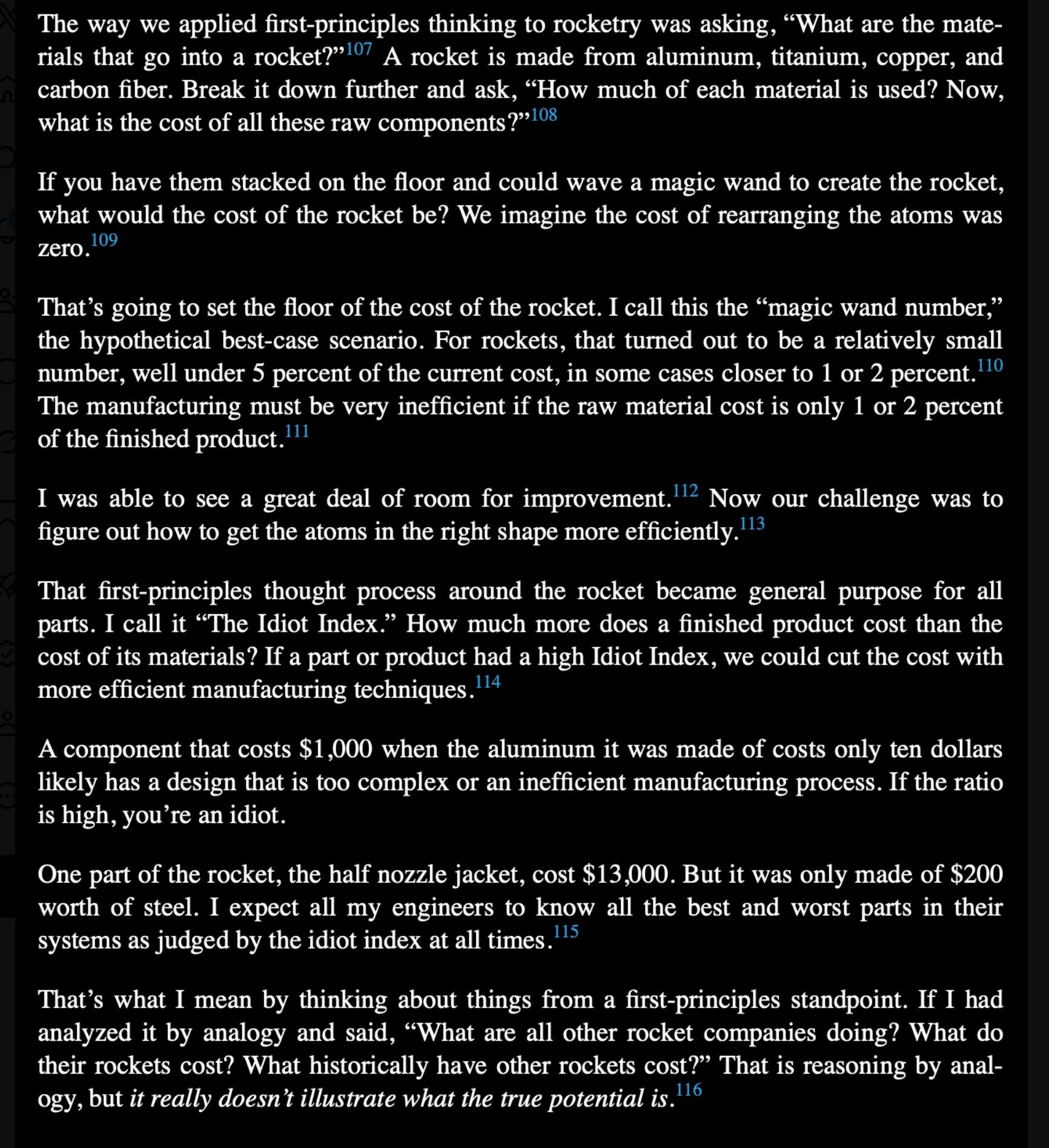
This bit from a book about Musk illustrates the mindset:
And the evolution of SpaceX’s Raptor engine demonstrates it:
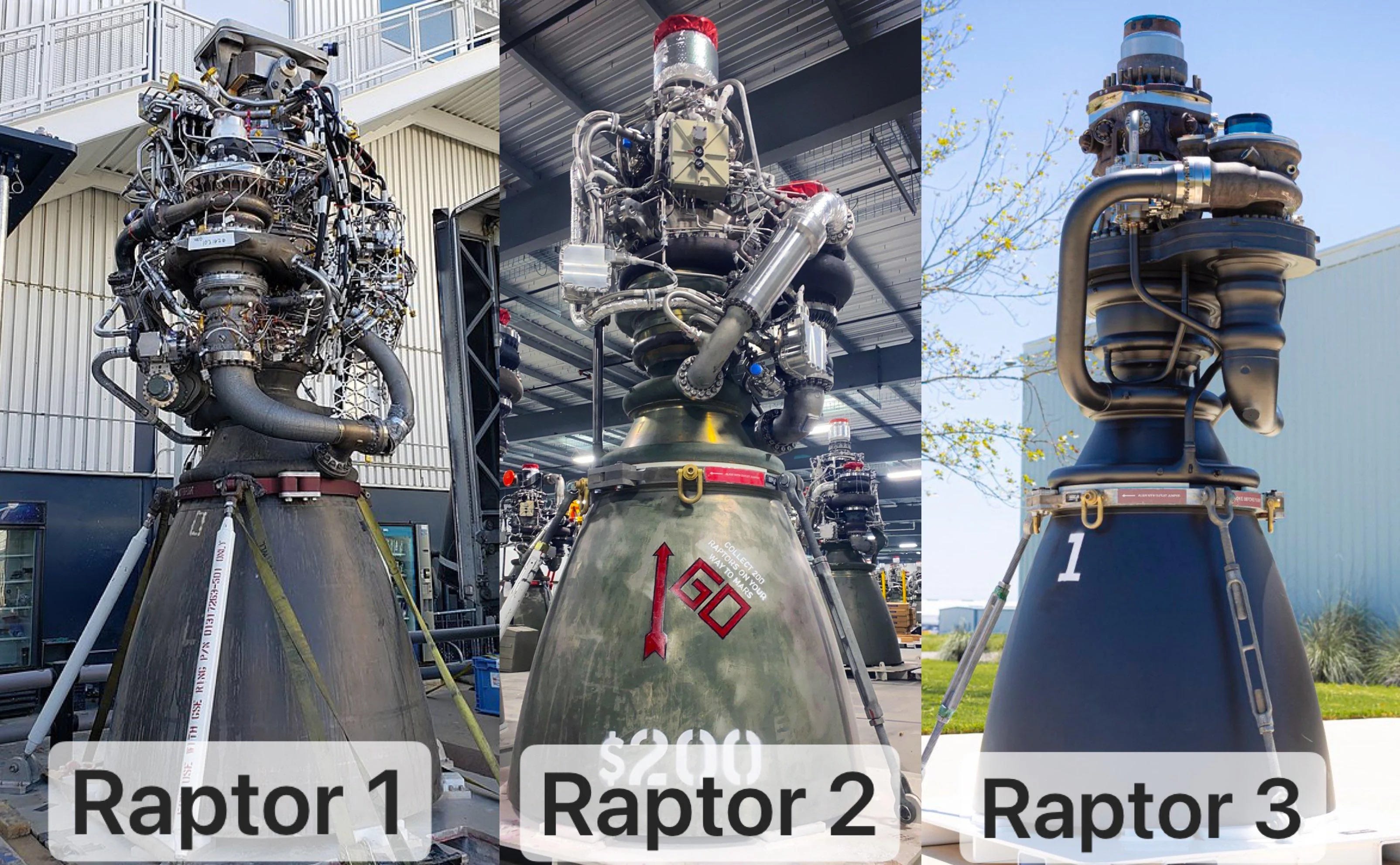
Rather than be content with having developed a working engine and turning focus to selling it, the company iterated improvements. Stuff like this doesn’t happen when government runs the show.
That’ll never change. Pournelle’s Iron Law tells us why:
...in any bureaucratic organization there will be two kinds of people: those who work to further the actual goals of the organization, and those who work for the organization itself. Examples in education would be teachers who work and sacrifice to teach children, vs. union representatives who work to protect any teacher including the most incompetent. The Iron Law states that in all cases, the second type of person will always gain control of the organization, and will always write the rules under which the organization functions.”
and also highlights what I have dubbed Peter’s Fourth Rule of Life:
Someone’s got to push.
In any large enterprise, the push has to come from the top. Steve Jobs was a perfectionist who constantly demanded things that he was told could not be done. Guess what? He often got what he demanded. People found a way.
Contrast this with your typical government-run endeavor. Many, many “chiefs” pulling in different directions, each with desires more selfish than the big picture. Congresspersons wanting business sent to their home states and districts. Managers being rotated out every couple years, each needing to leave his or her mark on a program and each knowing that predecessors’ poor decisions will reflect badly on them. Contractors working to specifications written by bureaucrats, rather than chasing continual improvements. Middle managers caring more about building their fiefdoms and protecting their team than serving the company’s interests. And on and on.
The difference is structural, inherent, and inevitable. It’s an unavoidable consequence of people focused on OPM, which is the essence of government.
I am fond of saying that government is terrible at everything it does. As is always the case with generalizations, there are instances where this is not true. However, unless those instances are many, the generalization stands. I am comfortable in declaring that I can find dozens of “bad” for every “good.”
Despite that general reality, there are things that even the freest, most minarchist societies still look to government to handle. We can and should debate how many things we assign to government, but based on the generalization, we should default to “as few as possible.” When we have ample evidence that the private sector is far superior at something, it should be a no-brainer to say “get government out of that business.”
The space race in the 1950s and 1960s was about national politics. In my younger days, I worked engineer veterans of the Apollo program, and they described a “money is no object” mindset that culminated with Apollo 11. That is obviously not an approach that is justifiable today, or even shortly after we won the race to the Moon. NASA didn’t take very long to turn bureaucratic once the 70s rolled around, and even more so once the Iron Curtain fell. The successes of the 1960s and the romance of space travel, heightened and perpetuated by a ton of science fiction and fantasy masquerading as science fiction, enhance public perception of NASA, but I repeat, it’s just another government agency subject to Pournelle’s Iron Law.
I know many who fantasize about humans colonizing Mars. I know that most who do have little or no knowledge of how hostile space and Mars are to human life, thanks again to science fiction romanticizing away many realities. Most of that hostility is an engineering problem, as in “time, money, manpower.” As I hope I have illustrated here, government is just awful at being efficient when it comes to “time, money, manpower.”
I also ask a more philosophical question: What justification is there to spend taxpayer dollars on sending humans into space, especially when the private sector is willing to spend its own money to do so?
Were I the big kahuna who gets to make big decisions, I’d reorient NASA’s role. Stop with “man-in-space.” Continue doing planetary science via unmanned deep space probes, which return far more science per buck than man-in-space. Concentrating the mission to science rather than lifting humans and all they need just to survive out of Earth’s gravity well would be a far more efficient use of taxpayer dollars. Yes, the purist libertarian would do away with NASA entirely, but change is always incremental and evolutionary, and we can reassess NASA after we do away with what should no longer be part of its purview.
Man-in-space will continue, because billionaires are willing to spend their own money pursuing it. I say, let ‘em. They’re spending their own money - and doing so far more efficiently than government. We will all reap the benefit.
Right now, where we truly are, there's no money to be made in space. There's a national security angle - yes, but that's limited to Earth orbit. For space to be profitable, we need to be building in space and for THAT to be profitable, we would need to be harvesting materials FROM space - asteroids. This negates the huge cost of lifting materials out of Earth's gravity well. But we need a demand signal to pay for that - which is what? I agree with you wholeheartedly that NASA is not the answer - not even part of the answer. I'd much prefer we leave it to geniuses like Musk to figure out the answer - to create that demand. Just as nobody needed an internal combustion engine 120 years ago, or nobody needed to fly, or candles and lanterns worked just fine after dark.
Same inn other parts of the government. Signal to noise seems to be optimized for noise