
The Truth About Tariffs


In 1845, economist Frederick Bastiat penned a petition to the government on behalf of candlemakers.
It starts out:
We candlemakers are suffering from the unfair competition of a foreign rival. This foreign manufacturer of light has such an advantage over us that he floods our domestic markets with his product. And he offers it at a fantastically low price. The moment this foreigner appears in our country, all our customers desert us and turn to him. As a result, an entire domestic industry is rendered completely stagnant. And even more, since the lighting industry has countless ramifications with other native industries, they, too, are injured.
It goes on to request that the product this foreign rival provides be blocked out by law. That the government institute mandates that would shield candlemakers from competition. And that, because this would swell demand for their product, a host of other domestic industries would benefit greatly.
Read the whole thing here.
The competitor the candlemakers wish debarred is, in fact, the sun.
The petition calls for the government to require citizens to close or shutter or block every window, skylight, and other form of access for the sunlight, so that people need to buy more candles. Candlemakers benefit, of course, but the increased demand for tallow means more livestock, meaning more meat, more wool, more leather, etc. The increased demand for oil would benefit olive and other farmers. Ditto for pine resin and whale oil, which would result in bigger forests and a booming shipping industry. Coal miners would benefit, as would sellers of candelabras and candlesticks.
In short, restricting the inflow of a foreign product would be a massive boom for the economy, with more jobs and benefits galore.
Sounds lovely, doesn’t it?
It’s the same argument made by our modern protectionists about tariffs, import quotas and bans, and other forms of restricting foreign products from coming onto our shores.
The idea’s fundamental flaw is the same one that Bastiat exposed in his Parable Of The Broken Window:
Opportunity cost.
The money consumers would have to spend on extra candles is money that can’t be spent on other things. Since the candles are more expensive than sunlight, the economic power of that extra money disappears. The effort required to produce that money is wasted. It’s the equivalent of cutting someone’s wage for the same volume of work. Imagine that, because the candlemakers succeeded in petitioning the government, your twenty dollars an hour is now effectively fifteen, because you have to spend more on illuminating your home.
This isn’t merely a shifting around of money. It is destruction. It is a reduction in economic productivity, which means lower living standards for all but the few who receive concentrated benefit at a broader and deeper cost to the whole. The petitioners come out a head, but the total wealth of the nation shrinks.
The “logic” and sophistry defending tariffs can feel overwhelming. It is born of emotion, of an “us vs them” tribalism that crowds out the plain truth. Opportunity cost feels like an abstraction, while irrelevant metrics such as trade deficits (no one ever calls them capital surpluses, which is what they are) stoke our lizard-brain outrage.
The simple truth is, when you can get the same product for less, or a better product for the same cost, you benefit and the economy benefits. Even when that product comes from somewhere else. Even when the resident of some foreign land gets employed by your purchase rather than some local chap. Vital to the analysis is the impact of the money you saved or the greater utility you gained. You can’t properly read a scale if you don’t put every relevant piece on it.
I cannot stress this enough. No economic argument is sound or complete if it does not include opportunity cost.
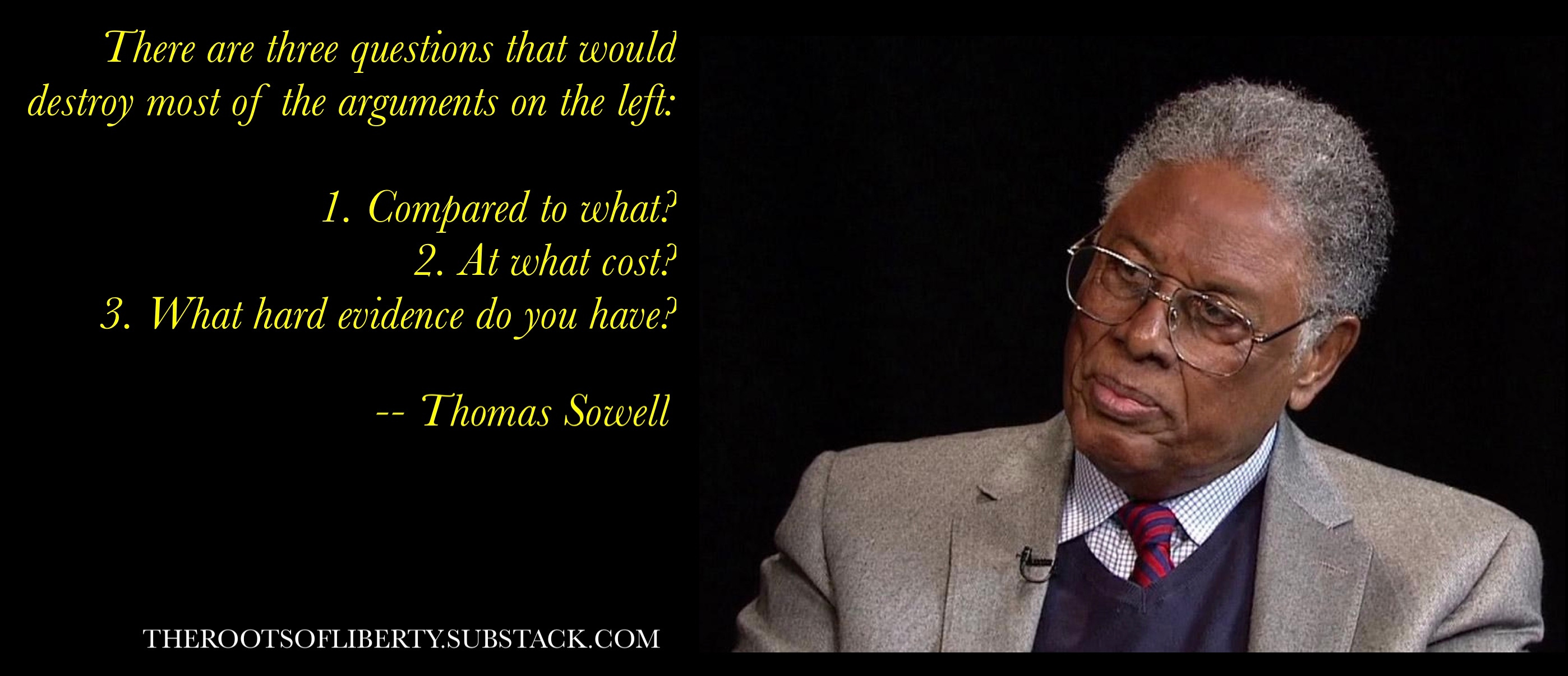
The second of Thomas Sowell’s “three questions” includes not just direct dollars spent, but the lost benefit of those dollars had they been deployed elsewhere.
When faced with this argument, many tariff defenders move the goalposts. One other argument is about re-shoring manufacturing to restore what has been lost. This relies on a false presumption (America is still the second leading manufacturer in the world, second only to a nation with triple our population) and a bad remedy. Want to re-shore manufacturing? Start by eliminating the government regulations and other distortions that make off-shoring manufacturing worthwhile. It’s far smarter to make it easier to compete than to make foreign products more expensive (or less available, thus forcing consumers to buy more expensive domestic products).
Tariffs are Trump’s biggest economic mistake. Their ill effects are masked by his positive efforts in deregulation, a saner energy policy than that of his predecessor, tax cuts, and a more business-friendly attitude in general. Those positives could all be done better, of course, because he still thinks “wrong” about the nature of government and the best use of its power in promoting economic growth. But that’s a big ball of yarn to unravel, so I’ll stay on point: Tariffs suck. No, the fact that other nations deploy them does not make them a good idea. And, no, tit-for-tat tariffs are not productive, either. They just compound the harm. If Joey jumps off a bridge, do you follow?
As has been often said before: Trade is good.