

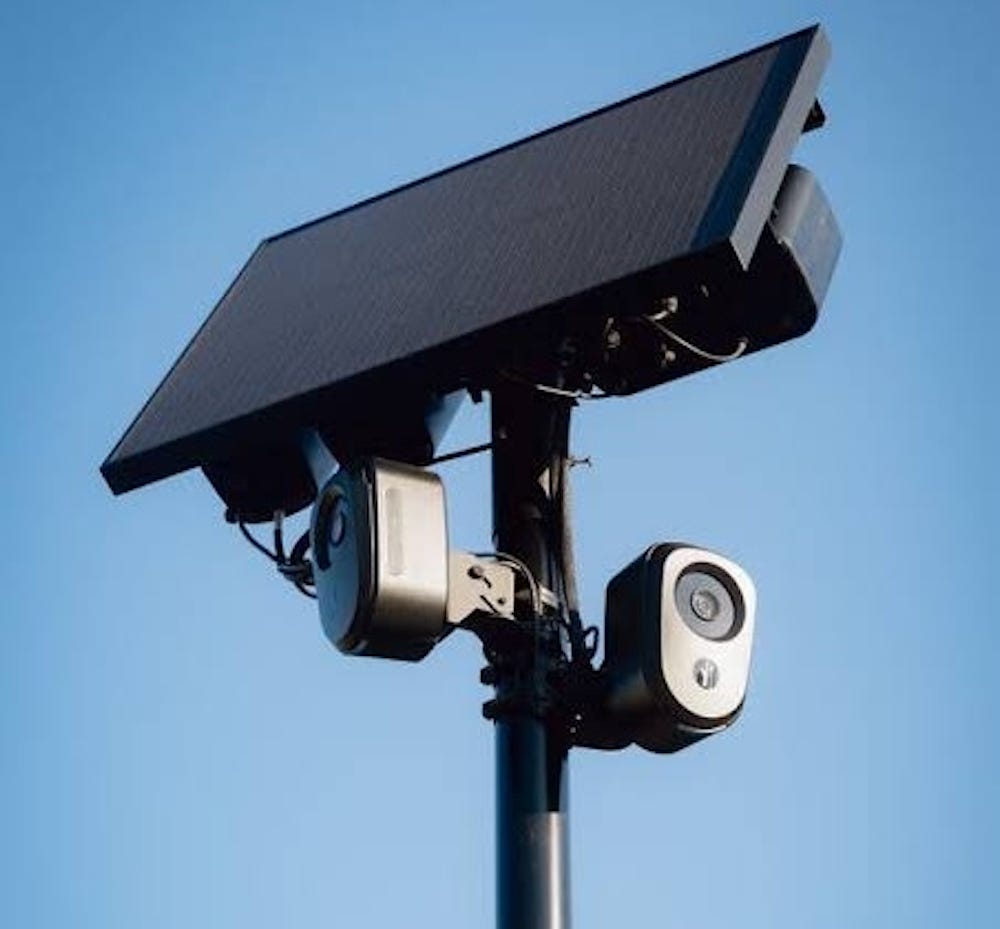
Firearm and 2A advocate Colion Noir recently shared a reel that questions the placement of ALPR (Automated License Plate Reader) cameras outside a gun range. The cameras (Flock or Flock-equivalent) were positioned so that all visitors to the gun range would be captured.
Noir correctly questions the purpose of these cameras. Are they collecting data merely in case something happens? Or is the information being piped into a permanent database? If the latter, congratulations, watchers, you now have a list of law-abiding people who own guns.
That’s not supposed to happen.
Federal law prohibits the government from building any such list.
Per Google:
Firearms Owners’ Protection Act (FOPA) of 1986: Section 6 of FOPA amended 18 U.S.C. § 926 to explicitly forbid the federal government from establishing any system of registration for firearms, gun owners, or transactions. It also bans recording or transferring dealer sales records to a facility owned, managed, or controlled by the United States or any state.
Why is this prohibition a Good Thing? Because history is chock-full of examples of nations creating firearms registries, then using those registries to disarm the civilian populace, then turning totalitarian.
The Left has for decades gnashed its teeth over their inability to disarm the American people. Rather than accepting the federal prohibition against registration or trying to change the law in an open and honest manner, it chases various work-arounds that would subvert the intent of FOPA and other laws.
One such work-around is the “universal background check” canard that’s often put forth as “closing the gun show loophole.” As I discuss here, the phrase “gun show loophole” is a red herring intended to get people to agree to further restrictions on our gun rights... and as a backdoor to universal registration. I discuss that* here and here.
I recently touched on the proliferation of ALPR cameras, and in particular the system offered by a company called Flock. I was disappointed by the number of conservatives that seemed perfectly fine with the collection and processing of detailed data about individuals’ daily movements, purportedly in the name of crime reduction, and supposedly because we have no right to privacy in public spaces.
While the latter is true, it is also true that the government cannot put a tracer on your car without a warrant. The government cannot surveil you for long periods of time without a warrant. There’s a difference between noticing your car traveled eastbound on Elm Street at eleven A.M. and compiling a detailed history of all your movements.
Consider that the government can ask the phone company who you call without a warrant, but it cannot listen to your conversations without one. This was the law adapting to emerging technology decades back, and the intersection of Big Data and mass surveillance calls for another adaptation.
Remember, also, that government has a very long history of misusing and abusing the tools that it has been granted and that it grants itself. Our nation was built by people who distrusted big government, and who crafted a set of laws intended to counterweigh the tendency of people in government to try to get away with as much as they can. We already have many instances of ALPR data abuse, and there will be many more. Absent requirements for warrants to access this data, we have to rely on self-policing and self-restraint. Neither will suffice when someone convinces himself that he’s Doing Good, and neither can survive the realities of the “blue wall of silence” that is part of law enforcement culture.
People want to make law enforcement’s job easier, because they believe that it will help reduce crime. That sounds great until they realize that doing so erodes their rights and privacy. With an absurd number of laws on the books and the reality that district attorneys routinely find creative ways to prosecute people they don’t like, giving the watchmen even more ways to abuse our liberties doesn’t sound like a very good idea to me.
This issue will ultimately come down to libertarian-leaning Red states banning the systems outright (Florida for now and more to follow) or emplacing such restrictions on the devices as to obviate our worst fears of abuse. Blue states, with radical leftist prosecutors, especially in and around large cities, will resist this movement for precisely the opposite reason. It'll be "tribal" for a season. Then some leftist prosecutor will overstep and abuse - and ultimately find his abuse presented before the courts. Whether he wins or loses, it will be appealed and so forth within the federal court system until a fundamental decision is reached. I cannot imagine these things survive constitutional scrutiny. Accepting a state-issued driver license doesn't confer unlimited surveillance authority to the state, as you noted.
You've given me some food for thought here. I didn't see much problem with them since businesses have cameras outside that track everything. Some cities do as well. However, outside a gun range is a whole different story. Thanks for widening my perspective